Hybrid Search
In short: Hybrid search runs keyword search and embedding search side by side and merges their results, so you catch both exact-term matches and same-meaning matches.
On this page
Level: Intermediate · Reading time: 9 min · Phase: 1 — RAG Foundations
Before you start: Embeddings and Metadata. You should know that an embedding is a list of numbers (a vector) that captures the meaning of text, and that metadata is extra labels (like year or source) stored with each chunk.
Explain it like I'm new
Imagine asking two librarians for help. One is a stickler for exact words: ask for "error E1234" and she finds every page that says E1234. The other understands meaning: ask "how do I reset my login?" and he finds the page titled "Password recovery". Each misses things the other finds. Hybrid search asks both and combines their lists.
The two librarians are:
- Sparse retrieval (keyword search), usually BM25. Great at exact terms: product codes, names, rare words, error messages.
- Dense retrieval (embedding search). Great at paraphrases and synonyms, weaker on rare exact strings it never saw in training.
The hard part is merging. BM25 scores might range from 0 to 25; cosine similarities from 0 to 1. You cannot just add them. Two common methods:
- Reciprocal Rank Fusion (RRF): ignore the raw scores, use only each document's rank in each list.
- Weighted score fusion: normalize both scores to 0–1, then combine, e.g.
0.5·dense + 0.5·sparse.
Words to know:
- Query: the question or search text the user types.
- Corpus: the whole collection of documents you search.
- Rank: a document's position in a result list (1 is the top).
- Fusion: merging several ranked lists into one.
- RRF: Reciprocal Rank Fusion, a merge method that uses only ranks.
- Normalize: rescale scores onto a common range, such as 0 to 1.
Watch it
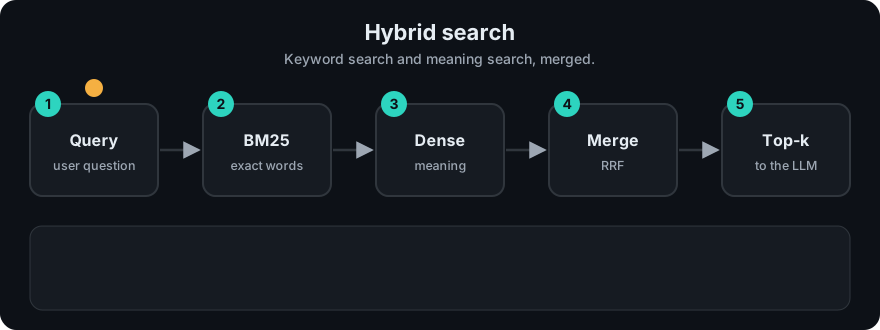
It plays on a loop. Read the caption in the box, one step at a time. Want to go at your own pace? Step through it with Previous and Next.
How it works
- Run the query through BM25 → ranked list A.
- Embed the query and run vector search → ranked list B.
- (Optional, recommended) apply the same metadata filter to both.
- Fuse the lists. With RRF, each document gets
score = Σ 1 / (k + rank)over the lists it appears in.kis a constant, commonly 60, that dampens the effect of top ranks. - Take the top results, optionally pass them to a reranker (a model that re-scores query–document pairs; see Phase 2).
flowchart LR
  Q[Query] --> S[BM25 / sparse]
  Q --> D[Embeddings / dense]
  S --> R1[Ranked list A]
  D --> R2[Ranked list B]
  R1 --> F[Fusion: RRF]
  R2 --> F
  F --> T[Top-k results]
Worked RRF example, k = 60:
| Doc | Rank in BM25 | Rank in dense | RRF score |
|---|---|---|---|
| d1 | 1 | 3 | 1/61 + 1/63 = 0.03227 |
| d2 | 2 | 1 | 1/62 + 1/61 = 0.03252 |
| d3 | — | 2 | 1/62 = 0.01613 |
Order: d2, d1, d3. d2 wins because both systems rank it high.
Worked example
The demo corpus has five short documents. Document 0 says "Refresh tokens belong in an httpOnly cookie and are rotated on every use." Document 3 is about Cache-Control, and document 1 is about access tokens. The query is "rotate refresh token". Real output:
- BM25 (exact words):
[(1.4727, 0)]. Only document 0 shares a whole word ("refresh") with the query, so BM25 returns just that one. - Dense (toy similarity of letter groups):
[(0.479, 0), (0.178, 3), (0.13, 1)]. It also surfaces documents 3 and 1 because they share some letter patterns. - Hybrid, after RRF:
[0, 3, 1]. Document 0 is first in both lists, so it wins. - Hybrid with a filter
year >= 2025:[0, 3]. Document 1 is from 2023, so it is removed. Documents 0 and 3 are from 2025, so they stay.
Code example
From code/rag_bm25.py. The "dense" side here is a toy character-trigram similarity so it runs offline; swap in real embeddings in practice.
def reciprocal_rank_fusion(rankings, k=60):
    scores = {}
    for ranking in rankings:
        for rank, doc_id in enumerate(ranking, start=1):
            scores[doc_id] = scores.get(doc_id, 0.0) + 1.0 / (k + rank)
    return sorted(scores, key=lambda d: (-scores[d], d))

def hybrid_search(query, docs, k=3, filters=None):
    texts = [d["text"] for d in docs]
    allowed = None
    if filters:
        allowed = {i for i, d in enumerate(docs) if matches(d["meta"], filters)}
    sparse = [i for _, i in BM25(texts).search(query, k=len(texts), allowed=allowed)]
    dense = [i for s, i in toy_dense_scores(query, texts, allowed) if s > 0]
    return reciprocal_rank_fusion([sparse, dense])[:k]

print(reciprocal_rank_fusion([["d1", "d2"], ["d2", "d3", "d1"]]))   # ['d2', 'd1', 'd3']
Run: cd 01-rag-foundations/code && python rag_bm25.py "rotate refresh token"
In real projects (LangChain, pip install langchain langchain-community rank_bm25):
from langchain_classic.retrievers import EnsembleRetriever   # LangChain 1.x; older: langchain.retrievers
from langchain_community.retrievers import BM25Retriever

bm25 = BM25Retriever.from_texts(chunks); bm25.k = 5
dense = vectorstore.as_retriever(search_kwargs={"k": 5})   # any LangChain vector store
hybrid = EnsembleRetriever(retrievers=[bm25, dense], weights=[0.5, 0.5])  # weighted RRF
docs = hybrid.invoke("error E1234 after password reset")
Many databases have hybrid search built in (Weaviate, Qdrant, Elasticsearch/OpenSearch, Milvus). Import paths change across LangChain versions; check the docs.
When to use it / when not to
- Use when queries mix exact identifiers and natural language: support tickets, code, legal or medical terms, product catalogues.
- A strong default for production RAG; it often helps over either method alone, but measure on your own data.
- Skip it if your evaluation shows dense alone is as good and you want a simpler stack.
| Method | Strength | Weakness |
|---|---|---|
| Sparse (BM25) | Exact terms, rare words, no training | Misses synonyms and paraphrases |
| Dense | Meaning, paraphrases | Rare codes, new jargon, needs a model |
| Hybrid | Both | Two indexes, fusion to tune |
Common mistakes
- Thinking hybrid search needs both lists to agree. A document found by only one side still gets a score and can rank well.
- Adding raw BM25 scores to cosine scores without normalizing.
- Filtering only one side, so forbidden documents re-enter through the other list.
- Using different chunks for the two indexes, so IDs do not line up.
- Fetching only top-3 from each side before fusion. Fetch more (e.g. 20–50), fuse, then cut.
Recap
If you remember only three things:
- Hybrid search runs keyword (sparse) and meaning (dense) search together and merges the two ranked lists.
- RRF merges by rank position only, so you never have to compare BM25 scores with cosine scores.
- Apply the same metadata filter to both sides, and fetch more than top-3 from each before fusing.
Interview questions
1. Why combine sparse and dense retrieval? <details><summary>Answer</summary> They fail differently. Sparse is good at exact terms and rare strings; dense is good at meaning and paraphrases. Combining them raises recall across both kinds of queries. </details>
2. How does Reciprocal Rank Fusion work and why is it popular? <details><summary>Answer</summary> Each document scores the sum of 1/(k + rank) over the lists it appears in. It uses only ranks, so it needs no score normalization or tuning beyond k, and it rewards documents that several retrievers agree on. </details>
3. What is a pitfall of weighted score fusion? <details><summary>Answer</summary> Scores from different systems have different scales and distributions. You must normalize them (e.g. min-max per query), and the weights need tuning on an evaluation set. </details>
Go deeper
- Cormack, Clarke & Büttcher, Reciprocal Rank Fusion outperforms Condorcet and individual rank learning methods (SIGIR 2009) — https://dl.acm.org/doi/10.1145/1571941.1572114
- LangChain retrievers (EnsembleRetriever) — https://python.langchain.com/