IVF Index
In short: An IVF (Inverted File) index groups vectors into clusters, then at query time searches only the few clusters closest to the query instead of every vector.
On this page
Level: Advanced · Reading time: 9 min · Phase: 1 — RAG Foundations
Before you start: Vector Databases and HNSW. You should know that a vector is a list of numbers that stands for the meaning of a chunk of text, and that an index is a structure that makes searching faster.
Explain it like I'm new
Imagine a huge library with no catalogue. To find a book about volcanoes you would check every shelf. Now imagine the books are sorted into sections: Geology, Cooking, History. You walk to Geology (and maybe Geography, just in case) and search only there. You skip 95% of the library.
IVF does this with vectors:
- Clustering groups similar vectors together. IVF uses k-means, an algorithm that finds
nlistcentre points (centroids) and assigns every vector to its nearest centroid. - Each cluster keeps a list of the vector IDs inside it. This list is the inverted list, borrowed from search-engine terminology.
- At query time, compare the query with the centroids only, pick the
nprobeclosest clusters, and do exact search inside them.
The risk: the true nearest neighbour might sit just across a cluster border, in a cluster you did not probe. Probing more clusters (bigger nprobe) lowers that risk and costs more time.
Words to know:
- Vector: a list of numbers that represents the meaning of a piece of text.
- Index: an extra structure built ahead of time so searches do not have to look at everything.
- Nearest neighbour: the stored vector closest to the query vector.
- Cluster / centroid: a group of similar vectors, and the centre point that represents the group.
nlist/nprobe: how many clusters you build, and how many clusters you search per query.- Recall: the share of searches that still find the true best answer.
Watch it
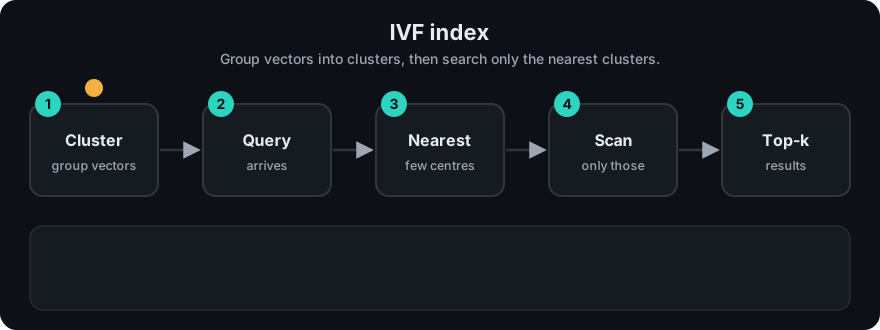
It plays on a loop. Read the caption in the box, one step at a time. Want to go at your own pace? Step through it with Previous and Next.
How it works
Training and adding
- Run k-means on a sample of vectors to get
nlistcentroids. This is the training step. - Assign every vector to its nearest centroid and append its ID to that cluster's list.
Searching
- Compute the distance from the query to all
nlistcentroids. - Pick the
nprobenearest clusters. - Compute exact distances to every vector inside those clusters.
- Return the best k.
          centroid A           centroid B
         .  . A  .            .   B .  .
          .  .  .               .  .  .
                         q  <- query is near A and B
          centroid C           centroid D
         .  . C  .            .  D  .
nprobe=1 -> search only A          (fast, may miss a neighbour in B)
nprobe=2 -> search A and B         (slower, safer)
nprobe=4 -> search everything      (= brute force)
Worked example from the demo: 200 vectors in 4 clusters, nlist = 4. With nprobe = 1, a query costs 4 centroid comparisons + about 50 vectors ≈ 54 distance computations, versus 200 for brute force. On the demo's random queries, recall@1 is 0.98 at nprobe = 1 and 1.00 at nprobe = 2. (Toy data; real recall depends on your data and settings.)
A common heuristic is to make nlist grow with the square root of the collection size (a few times √N for N vectors), then tune nprobe while measuring recall.
Worked example
Picture the diagram above with 200 vectors split into 4 clusters (A to D) of about 50 each, and a query q that lies between A and B.
- Compare
qwith the 4 centroids. A is closest, then B. That costs 4 comparisons. - With
nprobe = 1, search only the roughly 50 vectors in A. Total is about 54 comparisons instead of 200. If the true best match is in B, you miss it. That is the risk. - With
nprobe = 2, search A and B (about 100 vectors). Total is about 104. Now the match in B is found.
The demo agrees: recall@1 goes from 0.98 (nprobe = 1, 54 computations) to 1.00 (nprobe = 2, 104 computations).
Code example
From code/rag_hnsw_ivf.py:
class IVFIndex:
    def __init__(self, vectors, nlist=4, seed=0):
        self.vectors = vectors
        self.centroids, assign = kmeans(vectors, nlist, seed=seed)   # training
        self.lists = {c: [] for c in range(nlist)}
        for i, c in enumerate(assign):
            self.lists[c].append(i)                                   # inverted lists

    def search(self, query, k=1, nprobe=1):
        order = sorted(range(len(self.centroids)),
                       key=lambda c: dist(query, self.centroids[c]))
        candidates = [i for c in order[:nprobe] for i in self.lists[c]]
        candidates.sort(key=lambda i: dist(query, self.vectors[i]))
        return candidates[:k]
Run python rag_hnsw_ivf.py to print recall and work for nprobe = 1, 2, 4.
In real projects (pip install faiss-cpu numpy):
import faiss
import numpy as np

d, nlist = 128, 100
xb = np.random.rand(100_000, d).astype("float32")
quantizer = faiss.IndexFlatL2(d)                  # holds the centroids
index = faiss.IndexIVFFlat(quantizer, d, nlist)
index.train(xb)                                   # k-means
index.add(xb)
index.nprobe = 8                                  # clusters to search
D, I = index.search(xb[:5], 4)
IndexIVFPQ adds product quantization (compressing each vector into a few bytes) for very large collections.
When to use it / when not to
- Good for large collections where memory matters, especially combined with quantization (IVF-PQ).
- Fast to build compared with HNSW at large scale, but needs a training sample that represents your data.
- If the data distribution changes a lot after training, clusters get unbalanced; retrain.
- For small or medium collections that fit in RAM with low-latency needs, HNSW is often simpler.
nprobe | Speed | Recall |
|---|---|---|
| 1 | Fastest | Lowest |
~1–10% of nlist | Common balance | Usually high |
= nlist | Same as brute force | Exact |
Common mistakes
- Mixing up the two settings:
nlistis fixed when you build the index, whilenprobecan be changed on every search. - Training on too few vectors (k-means needs many points per centroid) or on unrepresentative data.
- Forgetting to call
train()beforeadd()in FAISS. - Leaving
nprobe = 1(FAISS default) and wondering why recall is poor. - Choosing
nlistfar too large for the data, giving many tiny or empty clusters.
Recap
If you remember only three things:
- IVF sorts vectors into clusters with k-means, then searches only the closest few clusters.
nprobeis the speed and recall dial: more clusters searched means better recall and slower queries.- Searching every cluster equals brute force, so IVF trades a little accuracy for a lot of speed.
Interview questions
1. How does an IVF index speed up search? <details><summary>Answer</summary> It clusters vectors with k-means and, at query time, only searches the nprobe clusters whose centroids are closest to the query, skipping most of the data. </details>
2. What do nlist and nprobe control? <details><summary>Answer</summary> nlist is the number of clusters (set at build time). nprobe is how many clusters are searched per query; higher nprobe means better recall and slower queries. </details>
3. Why can IVF miss the true nearest neighbour? <details><summary>Answer</summary> The neighbour may sit in a cluster near a border that was not among the nprobe probed clusters. Raising nprobe reduces this. </details>
Go deeper
- FAISS docs — https://faiss.ai/
- Johnson et al., Billion-scale similarity search with GPUs — https://arxiv.org/abs/1702.08734
Prev: HNSW · Next: Hybrid Search · Back to phase: Phase 1