BM25
In short: BM25 is a classic keyword-ranking formula that scores a document higher when it contains the query's words often, when those words are rare across the collection, and when the document is not padded with extra text.
On this page
Level: Intermediate · Reading time: 10 min · Phase: 1 — RAG Foundations
Before you start: Tokenization and Hybrid Search. You should know that text is split into small pieces called tokens (here, roughly words) before it is searched.
Explain it like I'm new
Imagine searching a pile of letters for "volcano eruption". A letter that says "volcano" five times is probably more relevant than one that says it once. But a letter that says "the" fifty times tells you nothing, because every letter has "the". And a 30-page letter that mentions "volcano" twice is less focused than a postcard that mentions it twice.
BM25 turns those three intuitions into a score:
- Term frequency (TF): how often the query word appears in the document. More is better, but with diminishing returns — the 10th mention adds much less than the 1st. This is called saturation.
- Inverse document frequency (IDF): rare words matter more. "Kubernetes" in a cooking corpus is a strong signal; "the" is not.
- Length normalization: long documents naturally contain more words, so their counts are scaled down relative to the average length.
"BM" stands for "Best Matching"; 25 is the version number from the original research series (Okapi BM25). It powers the default ranking in Lucene, Elasticsearch and OpenSearch. It needs no training and no GPU.
Words to know:
- Query: the search text the user types.
- Corpus: the whole collection of documents being searched.
- Term: one searchable word in the query or a document.
- Document frequency: how many documents contain a given term.
- Stop words: very common words like "the" that carry little meaning.
- Stemming: cutting a word to its base form, such as "running" to "run".
Watch it
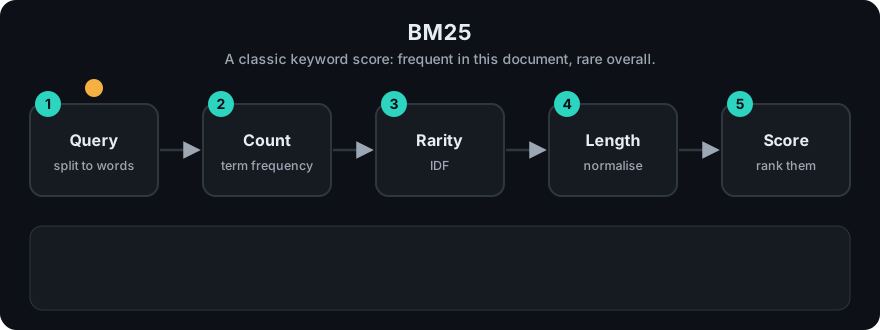
It plays on a loop. Read the caption in the box, one step at a time. Want to go at your own pace? Step through it with Previous and Next.
How it works
For a query with terms t and a document d:
score(q, d) = Σ over t in q   IDF(t) × tf(t,d) × (k1 + 1)
                              ---------------------------------------------
                              tf(t,d) + k1 × (1 − b + b × |d| / avgdl)

IDF(t) = ln( (N − df(t) + 0.5) / (df(t) + 0.5) + 1 )tf(t,d): times termtappears ind.df(t): number of documents containingt.N: total documents.|d|: document length in words.avgdl: average document length.k1(typically 1.2–2.0): how fast TF saturates.b(typically 0.75): how strongly length is normalized (0 = off, 1 = full).
Worked example
Take N = 3 documents ("cat dog", "cat bird", "cat fish"). The query term "fish" appears in 1 document, "cat" appears in all 3.
IDF(fish) = ln((3 − 1 + 0.5) / (1 + 0.5) + 1) = ln(2.667) ≈ 0.98IDF(cat) = ln((3 − 3 + 0.5) / (3 + 0.5) + 1) = ln(1.143) ≈ 0.13
"fish" carries about 7× more weight than "cat". Now saturation, with k1 = 1.5, b = 0 (no length effect): the TF part is tf × 2.5 / (tf + 1.5). For tf = 1 → 1.0; tf = 2 → 1.43; tf = 10 → 2.17. Ten mentions score barely double one mention.
Now the repo demo. It has five short documents, and the query is "rotate refresh token". BM25 returns [(1.4727, 0)]. Only document 0 ("Refresh tokens belong in an httpOnly cookie...") shares a whole word with the query, namely "refresh". "rotate" and "token" do not match, because the document says "rotated" and "tokens" and this demo does no stemming.
flowchart LR
  Q[Query terms] --> T[For each term]
  T --> I[IDF: rare = more weight]
  T --> F[TF with saturation k1]
  T --> L[Length normalization b]
  I --> S[Multiply and sum over terms]
  F --> S
  L --> S
  S --> R[Rank documents by score]
Code example
From code/rag_bm25.py:
import math, re
from collections import Counter

def tokenize(text):
    return re.findall(r"[a-z0-9]+", text.lower())

class BM25:
    def __init__(self, texts, k1=1.5, b=0.75):
        self.k1, self.b = k1, b
        self.tfs = [Counter(tokenize(t)) for t in texts]
        self.lengths = [sum(tf.values()) for tf in self.tfs]
        self.n = len(texts)
        self.avgdl = sum(self.lengths) / self.n
        self.df = Counter(term for tf in self.tfs for term in tf)

    def idf(self, term):
        d = self.df.get(term, 0)
        return math.log((self.n - d + 0.5) / (d + 0.5) + 1)

    def score(self, query, i):
        tf, length, s = self.tfs[i], self.lengths[i], 0.0
        for t in tokenize(query):
            f = tf.get(t, 0)
            if f:
                denom = f + self.k1 * (1 - self.b + self.b * length / self.avgdl)
                s += self.idf(t) * f * (self.k1 + 1) / denom
        return s

bm = BM25(["cat dog", "cat bird", "cat fish"])
print(round(bm.idf("fish"), 2), round(bm.idf("cat"), 2))   # 0.98 0.13
The repo version also removes stop words, supports filters and returns sorted results.
In real projects (pip install rank_bm25):
from rank_bm25 import BM25Okapi

corpus = [doc.lower().split() for doc in texts]
bm25 = BM25Okapi(corpus, k1=1.5, b=0.75)
scores = bm25.get_scores("rotate refresh token".split())
top = bm25.get_top_n("rotate refresh token".split(), texts, n=3)
At scale, use Elasticsearch/OpenSearch (BM25 is their default similarity) or a database with built-in full-text search.
When to use it / when not to
- Use for exact identifiers, names, codes, error messages and domain jargon.
- Use as a strong baseline before adding embeddings; and as the sparse half of hybrid search.
- Weak on synonyms and paraphrases ("car" vs "automobile") and across languages.
- Tokenization matters: decide on lowercasing, stemming (reducing "running" to "run") and stop words for your language.
Common mistakes
- Expecting a higher score to mean "correct". A score only ranks documents within one search; it is not a percentage.
- Different tokenization for documents and queries.
- Forgetting that scores are not comparable across queries or corpora; do not use a fixed score threshold blindly.
- Expecting BM25 to understand meaning.
- Indexing huge chunks, which dilutes term frequency and weakens length normalization.
Recap
If you remember only three things:
- BM25 scores a document by how often query words appear (with diminishing returns), how rare those words are, and how long the document is.
- It matches exact words only, so "rotate" will not match "rotated" unless you stem, and it cannot match synonyms.
- It needs no training, so it is a fast baseline and the keyword half of hybrid search.
Interview questions
1. What are the three ideas inside BM25? <details><summary>Answer</summary> Term frequency with saturation (k1), inverse document frequency (rare terms weigh more), and document length normalization (b). </details>
2. What do k1 and b do? <details><summary>Answer</summary> k1 controls how quickly repeated occurrences stop adding score. b controls how much longer-than-average documents are penalized; b = 0 disables length normalization. </details>
3. Why is BM25 still used in modern RAG systems? <details><summary>Answer</summary> It is fast, needs no training, is easy to explain, and handles exact terms and rare tokens that embedding models can miss. It is a strong baseline and the sparse side of hybrid search. </details>
Go deeper
- Robertson & Zaragoza, The Probabilistic Relevance Framework: BM25 and Beyond — https://dl.acm.org/doi/10.1561/1500000019
- Elasticsearch similarity settings (BM25) — https://www.elastic.co/guide/en/elasticsearch/reference/current/index-modules-similarity.html
Prev: Hybrid Search · Next: Sparse Retrieval · Back to phase: Phase 1