Ensemble Retrieval
In short: Ensemble retrieval runs several different retrievers (usually keyword and vector) on the same question and fuses their results into one ranked list.
On this page
Level: Intermediate · Reading time: 7 min · Phase: 2 — Advanced RAG
Before you start: Hybrid Search, BM25 and Bi-Encoder. Ensemble retrieval generalises hybrid search to any set of retrievers.
Explain it like I'm new
When you hire, you might ask two interviewers: one checks technical skills, one checks communication. Each misses things the other catches. Combining their rankings gives a better shortlist than either alone.
Retrievers have different blind spots:
- Sparse / keyword retrieval (e.g. BM25, a classic formula that scores documents by how often query words appear, adjusted for word rarity and document length) is great at exact terms: error codes, names, IDs. It fails on paraphrases.
- Dense / vector retrieval (a bi-encoder) is great at meaning and paraphrases. It can miss exact identifiers like
ERR_CONN_RESETorSKU-48812.
Ensemble retrieval, often called hybrid search when it combines exactly these two, runs both and merges the lists. Many vector databases offer hybrid search built in.
Words to know:
- Retriever: any component that takes a question and returns ranked documents.
- BM25: a classic keyword-scoring formula that rewards matching rare words.
- Dense retrieval: search by meaning using embeddings (lists of numbers capturing meaning).
- Fusion: merging several ranked lists into one.
- RRF (Reciprocal Rank Fusion): fusion that uses only each document's rank, not its raw score.
- Normalise: rescale scores to a common range, such as 0 to 1, so they can be added fairly.
Watch it
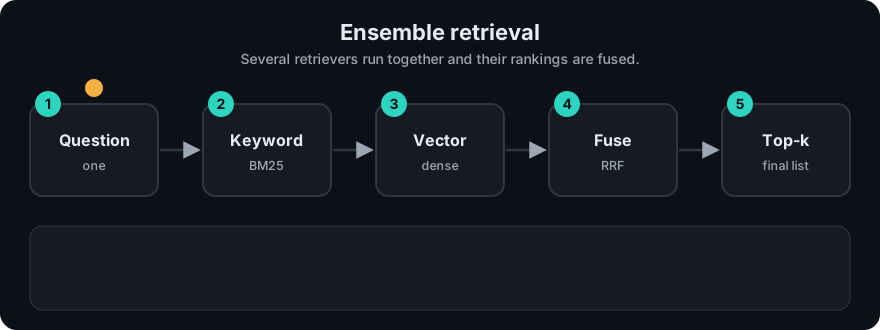
It plays on a loop. Read the caption in the box, one step at a time. Want to go at your own pace? Step through it with Previous and Next.
How it works
- Send the query to each retriever (in parallel).
- Get a ranked list from each.
- Fuse:
- Reciprocal Rank Fusion (RRF):
score(d) = Σ w_i / (60 + rank_i(d)). Only ranks matter. - Weighted score fusion: normalise each retriever's scores to 0–1, then
α·dense + (1−α)·sparse.
- Reciprocal Rank Fusion (RRF):
- Optionally rerank the fused top 50 down to 5.
flowchart LR
    Q[Query] --> B[BM25] --> F[Fusion<br/>RRF / weighted]
    Q --> V[Vector search] --> F
    F --> X[Optional reranker] --> T[Top k]
Weighted fusion worked example with α = 0.5:
| Doc | BM25 (normalised) | Dense (normalised) | Fused |
|---|---|---|---|
| A (contains "ERR_CONN_RESET") | 1.0 | 0.3 | 0.65 |
| B (paraphrase of the problem) | 0.1 | 1.0 | 0.55 |
| C | 0.4 | 0.4 | 0.40 |
Worked example
Question: "connection reset by proxy". Three documents: a mentions ERR_CONN_RESET and the proxy dropping connections, b says a connection keeps getting reset and to raise the proxy timeout, c is about TLS certificates. Real output from the code below:
- Keyword ranking:
['b', 'a', 'c'].bshares three query words (connection, reset, proxy).aandcshare one each (proxy). - Trigram ranking (overlapping 3-letter pieces, which are forgiving about spelling):
['a', 'b', 'c']. - Fuse with RRF, weights 0.5 each,
k=60:b: 0.5/(60+1) + 0.5/(60+2)a: 0.5/(60+2) + 0.5/(60+1), the same total.
aandbtie because each ranked first once and second once.cis last in both lists. The final list is['b', 'a', 'c'], with the tie broken by which document was seen first.
A document near the top of both lists beats one that is top of only one list. Ties like this are normal with two short lists.
Code example
A stdlib ensemble that fuses a keyword ranker and a character-trigram "semantic-ish" ranker with weighted RRF:
import re

DOCS = {
    "a": "ERR_CONN_RESET appears when the proxy drops idle connections.",
    "b": "If the connection keeps getting reset, raise the proxy idle timeout.",
    "c": "Configure TLS certificates for the proxy.",
}

def kw_rank(q):
    qw = set(re.findall(r"\w+", q.lower()))
    s = {d: len(qw & set(re.findall(r"\w+", t.lower()))) for d, t in DOCS.items()}
    return [d for d in sorted(s, key=lambda d: -s[d]) if s[d] > 0]

def trigram_rank(q):
    grams = lambda t: {t[i:i + 3] for i in range(len(t) - 2)}
    qg = grams(q.lower())
    s = {d: len(qg & grams(t.lower())) / len(qg | grams(t.lower())) for d, t in DOCS.items()}
    return sorted(s, key=lambda d: -s[d])

def weighted_rrf(rankings, weights, k=60):
    scores = {}
    for ranking, w in zip(rankings, weights):
        for r, d in enumerate(ranking, 1):
            scores[d] = scores.get(d, 0) + w / (k + r)
    return sorted(scores, key=lambda d: -scores[d])

q = "connection reset by proxy"
print(weighted_rrf([kw_rank(q), trigram_rank(q)], weights=[0.5, 0.5]))
See rrf_merge in adv_query_transform.py for the tested, unweighted version.
In real projects LangChain has an EnsembleRetriever that takes a list of retrievers and weights and fuses with weighted RRF; it is often paired with a BM25 retriever. Vector databases such as Weaviate, Qdrant, Elasticsearch/OpenSearch and others offer native hybrid search. See LangChain docs for current imports.
When to use it / when not to
- Use it as a strong default for production RAG, especially with technical content, names and codes.
- Use it when your eval shows dense search missing exact-match queries.
- Skip it for tiny prototypes where one retriever already scores well.
- Cost: two indexes to build and keep in sync, plus fusion tuning.
| Fusion | Needs score normalisation | Tuning |
|---|---|---|
| RRF | No | Little (weights optional) |
| Weighted score | Yes | α must be tuned on an eval set |
Common mistakes
- Adding raw BM25 scores (unbounded) to cosine scores (−1 to 1). Normalise first, or use RRF.
- Indexing different chunk sets in the two retrievers, so IDs don't line up.
- Picking weights by gut feel. Tune on a golden set.
- Forgetting to apply the same permission filters to both retrievers.
Recap
If you remember only three things:
- Ensemble retrieval runs several retrievers (usually keyword plus vector) and fuses their ranked lists.
- RRF only needs ranks, so it avoids the problem of mixing incompatible scores.
- Use the same chunks and the same permission filters in every retriever.
Interview questions
1. Why combine BM25 with dense retrieval? <details><summary>Answer</summary> They fail differently. BM25 nails exact tokens (IDs, rare names) but misses paraphrases; dense retrieval handles meaning but can miss exact identifiers. Fusing them improves recall across query types. </details>
2. RRF or weighted score fusion? <details><summary>Answer</summary> RRF is robust and needs no normalisation, so it's a good default. Weighted fusion can do better when tuned on an eval set, but depends on careful score normalisation. </details>
3. Where does a reranker fit in a hybrid pipeline? <details><summary>Answer</summary> After fusion: hybrid retrieval maximises recall over a candidate set (say 50), then a cross-encoder reranks for precision before the top few go to the LLM. </details>
Go deeper
Prev: Parent Document Retriever · Next: Knowledge Graph RAG · Back to phase: Phase 2