Step Back Prompting
In short: Step-back prompting first asks a more general question about the underlying concept, retrieves for that too, and uses both to answer the specific question.
On this page
Level: Advanced · Reading time: 6 min · Phase: 2 — Advanced RAG
Before you start: HyDE and Multi-Query Retrieval. Both use an LLM to rewrite the question before searching, and step-back is a third way to do that.
Explain it like I'm new
A student asks, "What happens to the pressure of a gas if the temperature doubles and the volume halves?" A good teacher first says, "Let's step back: what is the ideal gas law?" Once the principle is on the table, the specific answer is easy.
Specific questions often match no document directly. Your docs might explain how Kubernetes handles container health in general, but never mention your exact symptom. Step-back prompting asks an LLM to produce a step-back question: a broader, more abstract version ("How does Kubernetes manage container health and restarts?"). You retrieve for both the original and the step-back question. The general chunks give the model the principles; the specific chunks give it the details.
The technique comes from a 2023 Google DeepMind paper that showed abstraction-first prompting helped on reasoning-heavy tasks. In RAG, the same idea is used as a retrieval trick.
Words to know:
- LLM (large language model): the AI that reads and writes text, such as the model behind a chatbot.
- Retrieve: search your documents and fetch the best matches.
- Top k: the k best-scoring results (for example, top 3).
- Step-back question: a broader, more general version of the user's question.
- RRF (Reciprocal Rank Fusion): a simple way to merge several ranked lists. A document ranked high in any list ends up high in the merged list.
Watch it
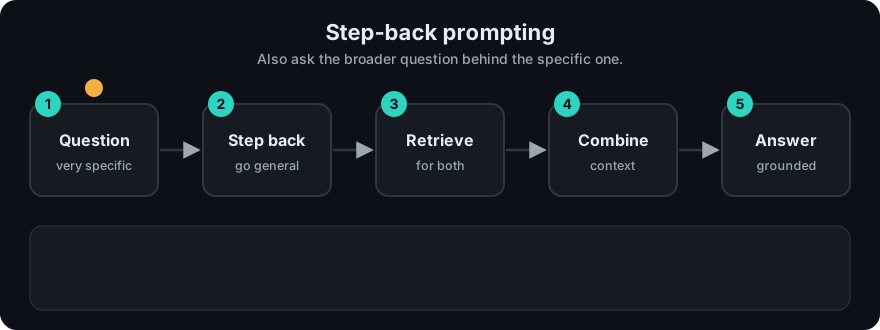
It plays on a loop. Read the caption in the box, one step at a time. Want to go at your own pace? Step through it with Previous and Next.
How it works
- Prompt the LLM to write a more general question.
- Retrieve top k for the original question.
- Retrieve top k for the step-back question.
- Merge (concatenate with labels, or fuse with RRF).
- Answer the original question using both sets of context.
flowchart TD
    Q["Specific: Why does my pod crash over and over?"] --> L[LLM: step back]
    L --> G["General: How does Kubernetes manage container health?"]
    Q --> R1[Retrieve]
    G --> R2[Retrieve]
    R1 & R2 --> M[Merge] --> A[Answer the specific question]
A prompt that works well includes one or two examples of step-back pairs, such as:
Original: Which team did Messi play for in 2010?
Step-back: What is Messi's career history?
Worked example
Question: "Why does my pod crash over and over?" (A pod is a running container group in Kubernetes. You only need to know it keeps crashing.) The demo has three small documents, d1, d2, d3. Real output from adv_query_transform.py:
- Plain search on the original question returns
['d2', 'd3'].d1, the document about liveness probes (Kubernetes health checks that restart a broken container), is missing, because it never mentions "crash". - Step back. The LLM writes: "How does Kubernetes manage container health and restarts?"
- Search again with that general question and merge both lists. Result:
['d1', 'd2', 'd3']. - The model now sees
d1(why restarts happen) next tod2andd3(your specific symptoms) and answers the original question.
The only change was one extra, broader search. It pulled in the document that explains the principle.
Code example
From adv_query_transform.py:
def step_back_prompt(question):
    return (
        "Write a more general, higher-level question whose answer would help answer the question below.\n"
        f"Question: {question}\nGeneral question:"
    )

def step_back_retrieve(question, llm, corpus=CORPUS, k=3):
    general = llm.complete(step_back_prompt(question)).strip()
    fused = rrf_merge([keyword_search(question, corpus, k), keyword_search(general, corpus, k)])
    return general, fused[:k]

general, top = step_back_retrieve("Why does my pod crash over and over?", FakeLLM())
print(general)  # How does Kubernetes manage container health and restarts?
print(top)      # ['d1', 'd2', 'd3']
The step-back query pulls in d1 (liveness probes restart containers), the general principle behind the crash loop.
When you build the answer prompt, label the context so the model knows which is which:
Background (general principles):
[d1] ...
Specific evidence:
[d2] ...
Question: Why does my pod crash over and over?
When to use it / when not to
- Use it for "why" and reasoning questions where principles matter (science, engineering, policy).
- Use it when documents are written at a general level and questions are specific.
- Skip it for simple fact lookups ("What is the refund window?"). It only adds cost.
- Skip it when the general question would retrieve huge amounts of loosely related text.
| Technique | What the LLM writes | Goal |
|---|---|---|
| Multi-query | Paraphrases | Cover phrasings |
| HyDE | A fake answer | Match document style |
| Step-back | A broader question | Fetch principles |
Common mistakes
- Replacing the original question with the step-back question. You need both.
- Stepping back too far ("What is computing?"), which retrieves generic noise.
- Not labelling general vs specific context, so the model answers the general question instead.
- Using it everywhere without measuring; for many factual queries it does not help.
Recap
If you remember only three things:
- Step-back prompting asks a broader question to fetch the general principles behind your specific question.
- Retrieve for both the original and the step-back question, then answer the original one.
- Skip it for simple fact lookups, where it only adds cost.
Interview questions
1. What is a step-back question? <details><summary>Answer</summary> A more abstract version of the user's question that targets the underlying concept or principle, e.g. "What is the ideal gas law?" for a specific gas-pressure problem. </details>
2. Why retrieve for both questions? <details><summary>Answer</summary> The general question brings in principles and background; the original brings specific facts. The answer usually needs both, and the original keeps the model focused on what was asked. </details>
3. When would step-back hurt? <details><summary>Answer</summary> On simple lookups, or when abstraction drifts off-topic. It adds an LLM call and can fill the context with broad, weakly relevant chunks. </details>
Go deeper
Prev: HyDE · Next: Self Query Retriever · Back to phase: Phase 2