Multi Query Retrieval
In short: Multi-query retrieval asks an LLM to rewrite one question into several different search queries, runs them all, and merges the results.
On this page
Level: Intermediate · Reading time: 8 min · Phase: 2 — Advanced RAG
Before you start: Query Expansion and Hybrid Search. You should know that a query is sent to a retriever, and that result lists from different searches can be combined.
Explain it like I'm new
If you lose your keys, you don't search one way. You check "where did I last drive", "which jacket was I wearing", "did I leave them in the door". Each angle finds different places. Together they cover much more ground.
A single user question is one angle. If it is phrased vaguely, or the documents phrase things differently, retrieval misses. Multi-query retrieval uses a large language model (LLM) to write, say, three alternative versions of the question. Each version goes to the retriever separately. You then merge the result lists into one ranking.
Words to know:
- Query variant: a rewrite of the question in different words or from a different angle.
- Retriever: the component that takes a query and returns the best-matching chunks.
- Rank: a document's position in a result list (1 is the top).
- Merge / fusion: combining several ranked lists into one.
- RRF: Reciprocal Rank Fusion, a merge method that uses only ranks.
The most common way to merge is Reciprocal Rank Fusion (RRF). It ignores raw scores (which are hard to compare across queries) and looks only at positions. Documents that rank well in many lists win.
Watch it
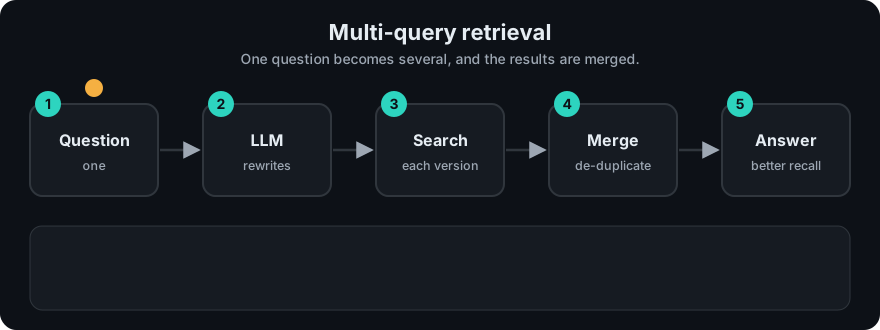
It plays on a loop. Read the caption in the box, one step at a time. Want to go at your own pace? Step through it with Previous and Next.
How it works
- Prompt an LLM: "Write 3 different search queries for this question, one per line."
- Keep the original question plus the 3 variants.
- Retrieve top k for each query.
- Merge with RRF: for each document,
score = Σ 1 / (60 + rank)over every list it appears in. The constant 60 is the usual default; it softens the gap between rank 1 and rank 2. - Take the top results and generate the answer with the original question.
flowchart TD
    Q[Question] --> L[LLM writes 3 variants]
    L --> Q1[Query 1] & Q2[Query 2] & Q3[Query 3]
    Q --> R0[Retrieve]
    Q1 --> R1[Retrieve]
    Q2 --> R2[Retrieve]
    Q3 --> R3[Retrieve]
    R0 & R1 & R2 & R3 --> F[RRF merge] --> T[Top k]
RRF worked example with k=60:
| Doc | Ranks in lists | RRF score |
|---|---|---|
| A | 1, 3 | 1/61 + 1/63 = 0.0164 + 0.0159 = 0.0323 |
| B | 2, 1, 1 | 1/62 + 1/61 + 1/61 = 0.0489 |
| C | 3 | 1/63 = 0.0159 |
B wins: it appears in three lists near the top.
Worked example
The repo demo runs the question "Why does my pod crash over and over?" with a fake LLM that returns fixed variants. So there are four queries, each searched separately (real output):
| Query | Result list |
|---|---|
| original question | d2, d3 |
| why does my pod restart | d2, d3 |
| CrashLoopBackOff meaning | d2 |
| liveness probe fails container restart | d1, d4 |
Merge with RRF (k=60), adding 1/(60+rank) per list:
d2: rank 1 in three lists, 3 × 1/61 = 0.0492d3: rank 2 in two lists, 2 × 1/62 = 0.0323d1: rank 1 in one list, 1/61 = 0.0164d4: rank 2 in one list, 1/62 = 0.0161 (just misses the top 3)
Final top 3: ['d2', 'd3', 'd1']. The single plain query returned only ['d2', 'd3'], so the extra variant found d1.
Code example
From adv_query_transform.py. FakeLLM returns fixed variants so it runs offline.
def rrf_merge(rankings, k=60):
    scores = {}
    for ranking in rankings:
        for rank, doc_id in enumerate(ranking, start=1):
            scores[doc_id] = scores.get(doc_id, 0.0) + 1.0 / (k + rank)
    return sorted(scores, key=lambda d: (-scores[d], d))

def multi_query_retrieve(question, llm, corpus=CORPUS, k=3):
    prompt = f"Write 3 different search queries that would help answer this question, one per line.\nQuestion: {question}"
    variants = [l.strip() for l in llm.complete(prompt).splitlines() if l.strip()]
    queries = [question] + variants
    rankings = [keyword_search(q, corpus, k=k) for q in queries]
    return queries, rrf_merge(rankings)[:k]
Run python adv_query_transform.py in 02-advanced-rag/code to see the merged ranking.
In real projects LangChain ships a MultiQueryRetriever that wraps any retriever and an LLM, and LlamaIndex has fusion retrievers that do the same with RRF. Module paths change between versions, so copy the import from the current docs: LangChain, LlamaIndex.
When to use it / when not to
- Use it for vague, short or multi-part questions ("compare X and Y").
- Use it when recall is your main problem and you can afford one extra LLM call.
- Skip it for exact lookups ("error E1042") where one query is already precise.
- Skip it when latency budgets are tight. You pay one LLM call plus N retrievals (run them in parallel).
| Single query | Multi-query + RRF | |
|---|---|---|
| LLM calls before retrieval | 0 | 1 |
| Retrieval calls | 1 | N+1 |
| Recall on vague questions | Lower | Higher |
Common mistakes
- Merging by raw similarity scores. Scores from different queries are not on the same scale; use RRF or normalise.
- Dropping the original question from the query set. It is often the best single query.
- Generating variants that all say the same thing. Ask for different angles or sub-questions.
- Running the N searches one after another instead of concurrently.
Recap
If you remember only three things:
- Multi-query retrieval has an LLM write several versions of the question, searches with each, and merges the lists.
- RRF merges by rank position only, so documents that appear high in many lists win.
- It costs one extra LLM call plus several searches, so keep the original question and run searches in parallel.
Interview questions
1. Why use RRF instead of summing similarity scores? <details><summary>Answer</summary> Scores from different queries or different retrievers (BM25 vs vectors) live on different scales. RRF uses only ranks, so it is scale-free, simple, and robust without tuning. </details>
2. What is the cost of multi-query retrieval? <details><summary>Answer</summary> One LLM call to generate variants plus N extra retrievals, which adds latency and spend. Retrievals can run in parallel; the LLM call is usually the main added delay. </details>
3. How is multi-query different from query decomposition? <details><summary>Answer</summary> Multi-query writes alternative phrasings of the same question. Decomposition splits a complex question into distinct sub-questions that may each need separate answers, which are then combined. </details>
Go deeper
- Retrieval-Augmented Generation for LLMs: A Survey (Gao et al.) — covers query rewriting and fusion
- LangChain documentation
Prev: Query Expansion · Next: HyDE · Back to phase: Phase 2