Multi Head Attention
In short: Multi-head attention runs several smaller attention operations side by side, so different heads can track different kinds of relationships at once.
On this page
Level: Intermediate · Reading time: 9 min · Phase: 3 · LLM Concepts
Before you start: Self Attention and Transformer Architecture.
Words to know:
- Head: one independent attention operation with its own Q, K, V matrices.
d_model: the length of each token's vector (its width).- Split / concatenate: cut a vector into equal pieces, or glue the pieces back end to end.
W_o: the learned output matrix that mixes the heads' results together.- KV cache: stored key and value vectors from earlier tokens, so they are not recomputed (see KV Cache).
Explain it like I'm new
Imagine reviewing a contract with a team. One person checks names and dates, another checks money amounts, a third checks who promised what to whom. Each reads the same document but looks for different links. At the end, you combine their notes.
Multi-head attention works the same way. Instead of one big attention with vectors of width 512, the model splits the width into, say, 8 heads of width 64. Each head has its own Q, K, V weight matrices, so it can learn its own idea of "relevant". Research has found heads that, for example, attend to the previous token or link pronouns to nouns, but there is no fixed rule about what a head learns.
The cost is roughly the same as one big head, because each head works on a smaller slice.
Watch it
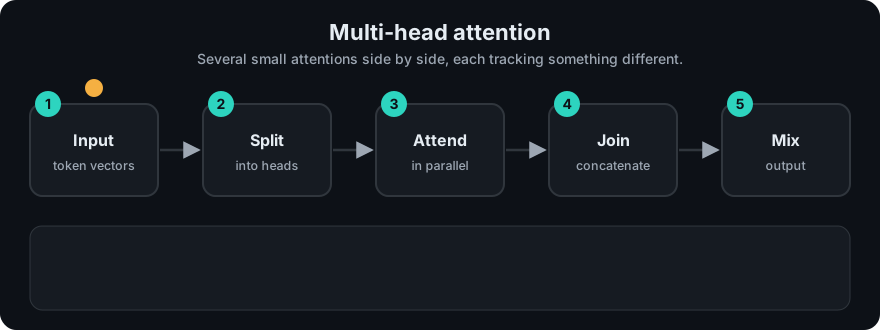
It plays on a loop. Read the caption in the box, one step at a time. Want to go at your own pace? Step through it with Previous and Next.
How it works
- Start with token vectors
Xof shapen × d_model. - Project into Q, K, V with learned matrices (each
d_model × d_model). - Split each of Q, K, V into
hheads: shapen × (d_model / h)per head. - Run scaled dot-product attention in each head independently.
- Concatenate the head outputs back to
n × d_model. - Multiply by an output matrix
W_oto mix information across heads.
X (3 tokens x 4 features)
        | split width into 2 heads
   +----+----+
 head 1    head 2        each: 3 x 2
 attention attention     (own Q,K,V)
   +----+----+
        | concat -> 3 x 4
        | x W_o
      output (3 x 4)
Numbers from the original paper: d_model = 512, h = 8, so each head has d_k = d_v = 64.
Variants you will see in modern LLMs:
- Multi-Query Attention (MQA): all heads share one K and one V. Smaller KV cache, faster decoding.
- Grouped-Query Attention (GQA): groups of query heads share K and V. A middle ground used by many open models.
Worked example
Take 3 tokens with 4 numbers each and 2 heads (the same X as the code example below).
- Split. Each token's 4 numbers become two pairs. Head 1 gets the first pair of every token:
[1,0],[0,1],[1,1]. Head 2 gets the last pair:[1,0],[0,1],[0,0]. - Attend separately. Each head builds its own 3 × 3 table of weights. Head 1's first row is
[0.4, 0.2, 0.4]. Head 2's first row is[0.5, 0.25, 0.25]. They differ because the heads see different features. - Odd case. In head 2, token 3 is
[0, 0], so all its scores are 0 and it spreads attention evenly:[0.33, 0.33, 0.33]. - Merge. Each head returns 3 × 2 numbers. Glued together they are 3 × 4 again, the same shape as the input.
- Mix. In a real model,
W_othen lets the two heads' results combine.
Code example
From llm_attention.py. Q = K = V = X here (no learned projections) so the split is easy to see.
from llm_attention import split_heads, merge_heads, multi_head_attention

X = [[1.0, 0.0, 1.0, 0.0],
     [0.0, 1.0, 0.0, 1.0],
     [1.0, 1.0, 0.0, 0.0]]

heads = split_heads(X, num_heads=2)
print(heads[0])   # [[1.0, 0.0], [0.0, 1.0], [1.0, 1.0]]  -> first 2 features of each token
print(heads[1])   # [[1.0, 0.0], [0.0, 1.0], [0.0, 0.0]]  -> last 2 features
assert merge_heads(heads) == X

out, weights = multi_head_attention(X, num_heads=2)
print(len(weights))  # 2 separate attention tables, one per head
Notice the heads see different features and so produce different attention tables. That is the whole point.
In real projects (PyTorch):
import torch
mha = torch.nn.MultiheadAttention(embed_dim=512, num_heads=8, batch_first=True)
x = torch.randn(2, 10, 512)          # (batch, tokens, features)
out, attn_weights = mha(x, x, x)     # self-attention
print(out.shape)                     # torch.Size([2, 10, 512])
When to use it / when not to
- Multi-head is the standard. You rarely choose "single head" in practice.
- More heads with the same width means smaller heads. Very small heads can lose expressive power.
- For inference memory, MQA or GQA reduce cache size with modest quality impact. This is a model-design choice, usually already made for you.
| Variant | K/V heads | KV cache size | Typical use |
|---|---|---|---|
| Multi-head (MHA) | h | largest | original transformer |
| Grouped-query (GQA) | g (1 < g < h) | medium | many current open LLMs |
| Multi-query (MQA) | 1 | smallest | fast decoding |
Common mistakes
- Choosing
d_modelnot divisible by the number of heads. The split fails. - Forgetting the output projection
W_o. Without it, heads cannot share information. - Assuming each head has a clear, human-readable job. Some do, many don't.
- Thinking more heads always means better quality. It is a trade-off.
Recap
If you remember only three things:
- Multi-head attention splits the vector width into several heads, and each head runs its own attention.
- The heads' outputs are glued back together and mixed with
W_o, so the output has the same shape as the input. - MQA and GQA share K and V across heads to shrink the KV cache.
Interview questions
1. Why use multiple heads instead of one big one? <details><summary>Answer</summary> Each head has its own projections, so different heads can attend to different positions and relationships at the same time. One head would average them into a single pattern. The compute cost is about the same because each head is narrower. </details>
2. What do GQA and MQA change, and why? <details><summary>Answer</summary> They let several query heads share the same key and value heads (all heads in MQA, groups in GQA). This shrinks the KV cache and memory bandwidth during decoding, which speeds up generation. </details>
3. If d_model is 4096 and there are 32 heads, what is the head dimension? <details><summary>Answer</summary> 4096 / 32 = 128. </details>
Go deeper
- Attention Is All You Need (Vaswani et al., 2017)
- Fast Transformer Decoding: One Write-Head is All You Need (Shazeer, 2019), multi-query attention
- GQA: Training Generalized Multi-Query Transformer Models (Ainslie et al., 2023)
Prev: Self Attention · Next: Positional Encoding · Back to phase: Phase 3