KV Cache
In short: The KV cache stores the key and value vectors of tokens already processed, so each new token only computes its own instead of recomputing the whole prefix.
On this page
Level: Advanced · Reading time: 9 min · Phase: 3 · LLM Concepts
Before you start: Self Attention and Decoder Only Models.
Words to know:
- Key (K) and value (V): two vectors each token produces. Later tokens use them to find and read this token's information.
- Prefix: the tokens that came before the current one.
- Prefill: the first step, which processes the whole prompt in one go.
- Decode step: producing one new token after the prompt.
- Cache: saved results that are reused instead of recomputed.
- GPU memory: the fast memory on the chip that runs the model. It is limited, and the cache uses it.
Explain it like I'm new
Imagine writing a long email and, before typing each new word, re-reading the entire email from the start. That is what a naive model does: to pick token 101, it reprocesses tokens 1-100 again. Then for token 102, it re-reads 1-101.
A KV cache is like keeping notes. After reading a word once, you write down what you need about it. For the next word, you just read your notes plus the new word.
Why keys and values? In self-attention, the new token's query must be compared to the keys of all earlier tokens and then mix their values. Thanks to the causal mask, earlier tokens never change when new ones are added, so their K and V stay the same. We can safely compute them once and keep them.
Watch it
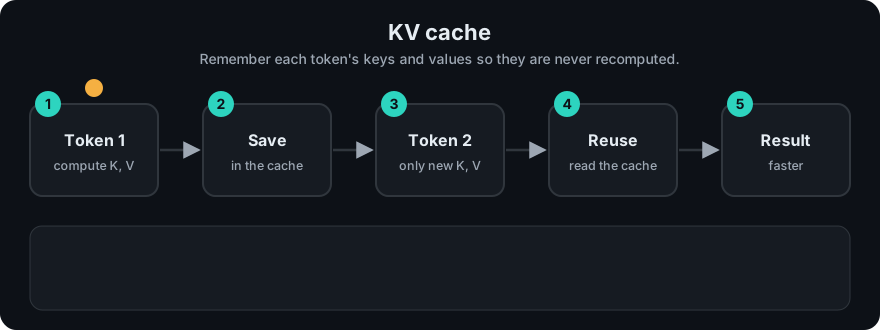
It plays on a loop. Read the caption in the box, one step at a time. Want to go at your own pace? Step through it with Previous and Next.
How it works
- Prefill. Run the whole prompt through the model in one parallel pass. Save K and V for every token, in every layer and every head.
- Decode step. For the new token only: compute its Q, K, V. Append K and V to the cache.
- Attend: the new Q against all cached K, mix all cached V.
- Produce the next token, repeat from step 2.
Worked example
Generate 4 tokens and count how many K,V pairs get computed.
| step | without cache | with cache |
|---|---|---|
| 1 | 1 (token 1) | 1 (token 1) |
| 2 | 2 (tokens 1-2) | 1 (token 2 only) |
| 3 | 3 (tokens 1-3) | 1 (token 3 only) |
| 4 | 4 (tokens 1-4) | 1 (token 4 only) |
| total | 1+2+3+4 = 10 | 4 |
The real demo prints the same pattern at bigger sizes: 10 tokens cost 55 without the cache and 10 with it.
Counting work. Generating n tokens:
- Without cache: step
tcomputes K,V forttokens, total1 + 2 + … + n = n(n+1)/2. - With cache: one new K,V per step, total
n.
| tokens n | without cache | with cache |
|---|---|---|
| 10 | 55 | 10 |
| 100 | 5,050 | 100 |
| 1,000 | 500,500 | 1,000 |
step 1: [K1 V1]
step 2: [K1 V1][K2 V2]              <- only K2,V2 are new
step 3: [K1 V1][K2 V2][K3 V3]        <- only K3,V3 are new
         \___________ reused from cache ___________/
The cost: memory. Cache size per token is roughly:
2 (K and V) × layers × kv_heads × head_dim × bytes_per_numberExample with made-up but realistic sizes: 32 layers, 8 KV heads, head_dim 128, 16-bit numbers (2 bytes): 2 × 32 × 8 × 128 × 2 = 131,072 bytes ≈ 128 KB per token. At 8,000 tokens that is about 1 GB for one conversation. That is why long contexts and many users are memory-bound, and why GQA/MQA exist.
Related ideas:
- Prompt caching (offered by API providers): reuses the cache for a repeated prompt prefix across requests, lowering cost and latency.
- PagedAttention (vLLM): stores the cache in blocks like OS memory pages, so many requests share GPU memory well.
Code example
From llm_decoding.py:
def count_kv_computations(num_tokens, use_cache):
    computed = 0
    for t in range(1, num_tokens + 1):
        computed += 1 if use_cache else t   # cache: only the new token; no cache: whole prefix
    return computed

for n in (10, 100, 1000):
    print(n, count_kv_computations(n, False), count_kv_computations(n, True))
# 10 55 10
# 100 5050 100
# 1000 500500 1000
In real projects the Hugging Face generate() method uses the cache by default (use_cache=True in the model config). Serving engines such as vLLM manage it for you.
When to use it / when not to
- Always for autoregressive generation. Every serious inference engine uses it.
- It does not speed up the prefill step much; it speeds up each decode step.
- Watch memory: long prompts × many concurrent users can exhaust GPU memory.
- Put stable content (system prompt, documents) first in prompts so provider prompt caching can reuse it.
Common mistakes
- Thinking the cache stores outputs or tokens. It stores per-layer key and value tensors.
- Forgetting that the cache grows linearly with context length and batch size.
- Changing an early part of the prompt and expecting cache reuse. Any change invalidates everything after it.
- Confusing the KV cache (inside one generation) with a semantic/response cache (reusing whole answers).
Recap
If you remember only three things:
- Earlier tokens' keys and values never change, so we compute them once and store them in the KV cache.
- The cache turns the work from about
n(n+1)/2ton: for 1,000 tokens, 500,500 down to 1,000. - The price is GPU memory, which grows with context length, layers, KV heads and the number of users.
Interview questions
1. Why can we cache K and V but not Q? <details><summary>Answer</summary> With causal attention, earlier tokens' K and V never change when new tokens arrive, and future queries need them. A query is only used once, by its own token, at its own step, so there is nothing to reuse. </details>
2. What is the main downside of the KV cache? <details><summary>Answer</summary> Memory. It grows linearly with sequence length, layers, KV heads, and batch size, and often limits how many requests or how long a context a GPU can serve. </details>
3. Name two techniques that reduce KV-cache memory. <details><summary>Answer</summary> Grouped-query or multi-query attention (fewer K/V heads), quantizing the cache to fewer bits, paged memory management (PagedAttention), or sliding-window attention that drops old tokens. </details>
Go deeper
- Efficient Memory Management for LLM Serving with PagedAttention (Kwon et al., 2023)
- Fast Transformer Decoding: One Write-Head is All You Need (Shazeer, 2019)
Prev: Encoder Decoder Models · Next: Context Window · Back to phase: Phase 3