Long-term Memory
In short: Long-term memory is information an agent saves outside the model (in a database or file) so it can search and reuse it in future sessions.
On this page
Level: Intermediate · Reading time: 7 min · Phase: 4 · Agentic AI
Before you start: Short-term Memory. You should know that the model only "remembers" what is inside the current prompt.
Explain it like I'm new
Short-term memory is the sticky note for today's call. Long-term memory is the filing cabinet. You file away things worth keeping ("client prefers email, not calls"; "the deploy script is in scripts/deploy.sh"), and the next time a related topic comes up, you pull the right folder.
For an agent, the filing cabinet is a store: a database table, a JSON file, or a vector database (a database that finds items by meaning using embeddings). The flow has two halves:
- Write: decide what is worth saving and save it, with metadata (who, when, source).
- Read: given a new question, retrieve the most relevant saved items and add them to the prompt.
If that sounds like RAG, it is. Long-term memory is RAG over things the agent (or user) learned, instead of over a fixed document set. RAG (retrieval-augmented generation) means looking up relevant text and pasting it into the prompt. See Phase 1 · RAG Foundations.
Words to know:
- Session: one continuous conversation or run. Long-term memory survives after it ends.
- Store: the place memories are saved (a file, a database, or a vector database).
- Metadata: extra labels on a memory, such as who it belongs to and when it was saved.
- Retrieve: search the store and return the best-matching items.
- Top-k: the k best matches. With
k=2you get the two best. - Embedding: a list of numbers that represents the meaning of a text, so similar meanings land close together.
Watch it
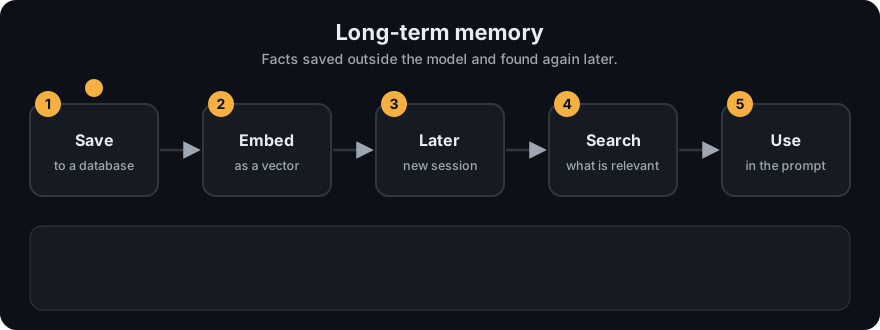
It plays on a loop. Read the caption in the box, one step at a time. Want to go at your own pace? Step through it with Previous and Next.
How it works
- Extract. After a turn or a task, decide what to save. Options: save everything; save only what the user explicitly asks ("remember that…"); or ask the LLM to extract key facts.
- Store each item with metadata:
user_id, timestamp, source, and type (fact, note, episode). - Index for search: keywords (simple), embeddings (meaning-based), or both (hybrid).
- Retrieve top-k items for the new question, filtered by user so one user never sees another's memories.
- Inject them into the prompt with a clear label ("Relevant notes from past sessions:").
- Maintain: update, merge duplicates, and delete stale or wrong items.
flowchart LR
    subgraph Write
      T[turn / task result] --> X[extract facts or notes] --> S[(store + index)]
    end
    subgraph Read
      Q[new question] --> R[search store, filter by user] --> P[add top-k to prompt]
    end
    S --> R
Worked example
This uses the LongTermMemory class from the code below (real output from agent_memory.py).
- Session 1: the agent saves two notes:
The deploy script lives in scripts/deploy.shandStaging database password rotates every 30 days. - Session 2, days later: the user asks
where is the deploy script. searchdrops filler words such astheandis, then counts shared words. The first note sharesdeployandscript(score 2). The second shares none (score 0) and is thrown away.- The best match is added to the prompt as
Relevant note: The deploy script lives in scripts/deploy.sh.
Real output: ['The deploy script lives in scripts/deploy.sh']. The model answers correctly even though it never saw that note in this session.
Code example
From agent_memory.py: a keyword store with save, ranked search, and JSON persistence. Swap tokenize + overlap for embeddings + cosine similarity to get a vector store.
import json, re

STOP = {"the", "a", "is", "of", "to", "in", "how", "where"}
def tokenize(text):
    return [w for w in re.findall(r"[a-z0-9]+", text.lower()) if w not in STOP]

class LongTermMemory:
    def __init__(self):
        self.items = []

    def save(self, text):
        self.items.append({"text": text, "words": set(tokenize(text))})

    def search(self, query, k=2):
        q = set(tokenize(query))
        scored = [(len(q & it["words"]), i, it["text"]) for i, it in enumerate(self.items)]
        scored = [s for s in scored if s[0] > 0]
        scored.sort(key=lambda s: (-s[0], -s[1]))      # most overlap, then newest
        return [text for _, _, text in scored[:k]]

    def dump(self):
        return json.dumps([{"text": it["text"]} for it in self.items])

ltm = LongTermMemory()
ltm.save("The deploy script lives in scripts/deploy.sh")
ltm.save("Staging database password rotates every 30 days")
print(ltm.search("where is the deploy script"))   # ['The deploy script lives in scripts/deploy.sh']
dump() / load() let the memory survive a restart; test_long_term_survives_dump_and_load checks it.
In real projects you'd use a vector store such as FAISS, Chroma, or pgvector, or a framework memory store (for example LangGraph's long-term memory store). The read/write logic stays the same.
When to use it / when not to
- Use when users come back and expect continuity (preferences, project details, past decisions).
- Use for agents that should learn from past tasks (combine with episodic memory).
- Skip for one-off, single-session tools; it adds storage, privacy, and complexity.
| Retrieval | Finds | Misses |
|---|---|---|
| Keyword | exact terms, IDs, names | synonyms ("car" vs "vehicle") |
| Vector | similar meaning | exact codes, rare names |
| Hybrid | both | more moving parts |
Common mistakes
- No user filter, so memories leak between users.
- Saving everything, so retrieval returns noise.
- Never deleting or updating, so outdated facts win.
- Saving untrusted tool output as trusted memory (memory poisoning).
- Not telling the model where a memory came from or how old it is.
Recap
If you remember only three things:
- Long-term memory is a store outside the model that you write to and search later, so knowledge survives across sessions.
- It is RAG over what the agent learned: retrieve the top matches and put them in the prompt.
- Filter by user, save selectively, and delete stale items, or it becomes leaky and noisy.
Interview questions
1. How is long-term memory related to RAG? <details><summary>Answer</summary> It uses the same retrieve-then-generate mechanism. The difference is the source: long-term memory stores information gathered during use (facts, notes, past outcomes), often per user, while classic RAG searches a prepared document set. </details>
2. How do you decide what to write to long-term memory? <details><summary>Answer</summary> Common strategies: explicit user requests, LLM-based extraction of durable facts at the end of a session, and saving task outcomes. Filter out trivia and untrusted content, de-duplicate, and attach metadata. </details>
3. What security issue is specific to agent memory? <details><summary>Answer</summary> Memory poisoning: malicious content saved into memory can resurface later as trusted context and steer the agent. Mitigate by tagging sources, not auto-saving untrusted text, and reviewing or expiring memories. </details>
Go deeper
- Generative Agents: Interactive Simulacra of Human Behavior (Park et al., 2023)
- MemGPT: Towards LLMs as Operating Systems (Packer et al., 2023)
- LangGraph documentation
Prev: Short-term Memory · Next: Semantic Memory · Back to phase: Phase 4