Episodic Memory
In short: Episodic memory is a log of the agent's past experiences (what task it tried, what it did, and how it turned out) that it can recall to do better next time.
On this page
Level: Intermediate · Reading time: 7 min · Phase: 4 · Agentic AI
Before you start: Long-term Memory and Semantic Memory. You should know how agents save and search information outside the model, and how facts differ from events.
Explain it like I'm new
Last time you assembled flat-pack furniture, you put the doors on before the shelves and had to start over. Next time, you remember that episode and do the shelves first. You're not recalling a general fact; you're recalling a specific event and its lesson.
Agents can do the same. After each task, save a record:
- task: "deploy to staging"
- actions: ["run tests", "deploy"]
- outcome: failure
- lesson: "run database migrations before deploying"
Next time a similar task arrives, the agent looks up similar episodes and adds them to the prompt: "Last time this failed because migrations weren't run." This is the memory side of Reflection; the Reflexion paper stores exactly these kinds of verbal lessons between attempts.
Episodic memory is also gold for you, the developer: it's a record of what the agent did, useful for debugging and evaluation.
Words to know:
- Episode: one past attempt at a task, saved as a record.
- Outcome: how the attempt ended, such as success or failure.
- Lesson: a short sentence about what to do differently next time.
- Recall: find the saved episodes most similar to the new task.
- Prune: delete old or useless records so recall stays clean.
Watch it
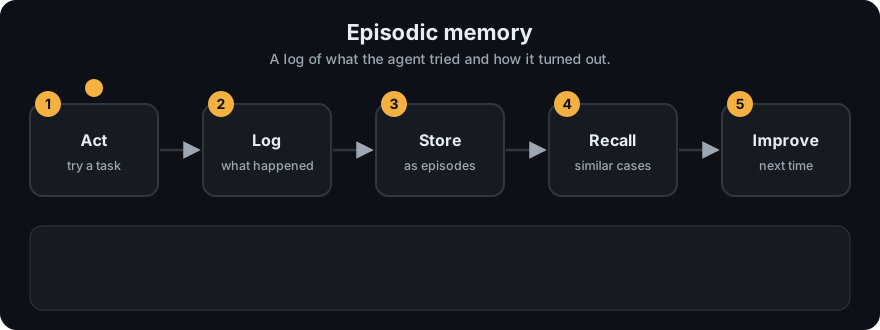
It plays on a loop. Read the caption in the box, one step at a time. Want to go at your own pace? Step through it with Previous and Next.
How it works
- Record at the end of each task (or each attempt): task description, key actions, outcome, timestamp, and an optional lesson. The lesson can come from a reflection step.
- Index by task similarity (keywords or embeddings) and time.
- Recall the most similar episodes when a new task starts. Prefer recent ones and include both failures (to avoid) and successes (to copy).
- Inject a short summary, not the raw logs: "Similar past task: deploy staging → failed. Lesson: migrate first."
- Prune old or irrelevant episodes so recall stays useful.
sequenceDiagram
    participant Agent
    participant Episodes as Episodic store
    Agent->>Episodes: recall("deploy to staging")
    Episodes-->>Agent: t=1 failure, lesson "migrate first"
    Agent->>Agent: plan includes "migrate" step
    Agent->>Episodes: record(task, actions, outcome=success)
Worked example
This traces the EpisodicMemory code below (real output).
- Attempt 1 at
deploy to staging: actionsrun tests,deploy. It fails. The agent records it with the lessonrun migrations before deploy. The record gets timet=1. - Attempt 2 is a different task,
write weekly report. It succeeds, sot=2, with no lesson. - Attempt 3 at
deploy to staging: this time the agent recalls first.recall("deploy staging")matches only the two deploy episodes, and ranks the newest first. It then adds themigratestep and succeeds (t=3). - Real output of the recall:
3 success ['run tests', 'migrate', 'deploy']then1 failure ['run tests', 'deploy'] run migrations before deploy.
The weekly report episode never shows up, because it shares no words with the new task. failures() returns ['run migrations before deploy'].
Code example
From agent_memory.py:
from agent_memory import EpisodicMemory

epi = EpisodicMemory()
epi.record("deploy to staging", ["run tests", "deploy"], "failure", lesson="run migrations before deploy")
epi.record("write weekly report", ["draft"], "success")
epi.record("deploy to staging", ["run tests", "migrate", "deploy"], "success")

for e in epi.recall("deploy staging", k=2):
    print(e["t"], e["outcome"], e["actions"], e["lesson"])
# 3 success ['run tests', 'migrate', 'deploy']
# 1 failure ['run tests', 'deploy'] run migrations before deploy

print([e["lesson"] for e in epi.failures()])   # ['run migrations before deploy']
Turning recalled episodes into prompt text:
def episodes_to_prompt(episodes):
    lines = ["Similar past tasks:"]
    for e in episodes:
        lesson = f" Lesson: {e['lesson']}" if e["lesson"] else ""
        lines.append(f"- {e['task']} -> {e['outcome']} via {', '.join(e['actions'])}.{lesson}")
    return "\n".join(lines)
When to use it / when not to
- Use for agents that repeat similar tasks (ops runbooks, support, coding agents) and can learn from mistakes.
- Use the same records for debugging and evals.
- Skip for one-off assistants with no repeated tasks.
- Old lessons can become wrong when systems change. Add timestamps and expiry.
Common mistakes
- Storing full raw transcripts and injecting them, which wastes tokens. Store summaries and lessons.
- Only saving successes; failures carry the most useful lessons.
- No similarity filter, so unrelated episodes clutter the prompt.
- Treating an old lesson as permanent truth after the environment changed.
Recap
If you remember only three things:
- Episodic memory stores specific past attempts: the task, the actions, the outcome, and a lesson.
- Before a new task, recall similar episodes and add a short summary to the prompt.
- Keep failures and lessons, not raw transcripts, and expire lessons that may be out of date.
Interview questions
1. What does an episodic memory record usually contain? <details><summary>Answer</summary> The task, the key actions taken, the outcome (success/failure, scores), a timestamp, and optionally a lesson or reflection for next time. </details>
2. How does episodic memory relate to Reflexion? <details><summary>Answer</summary> Reflexion has the agent write verbal reflections after failed attempts and keep them in a memory buffer that is added to the context on later attempts. That buffer is a form of episodic memory. </details>
3. How would you keep episodic memory useful over months? <details><summary>Answer</summary> Retrieve by similarity and recency, store compact summaries rather than raw logs, expire or re-validate old lessons, and de-duplicate repeated episodes. </details>
Go deeper
- Reflexion: Language Agents with Verbal Reinforcement Learning (Shinn et al., 2023)
- Generative Agents: Interactive Simulacra of Human Behavior (Park et al., 2023)
Prev: Semantic Memory · Next: Agent Loops · Back to phase: Phase 4