LoRA and PEFT (cheap fine-tuning)
In short: LoRA freezes the big model and trains two tiny matrices whose product is added to each chosen weight matrix, so you train well under 1% of the parameters and still change the model's behaviour.
On this page
Level: Advanced · Reading time: 9 min · Phase: 3 · LLM Concepts
Before you start: Fine-Tuning (the overview) and Quantization.
Words to know:
- Matrix: a grid of numbers. A model's weights are stored as many matrices.
- Rank (r): how many independent directions of change the add-on can carry.
- Adapter: the small trained add-on, which you can load or remove.
Explain it like I'm new
Imagine a huge printed textbook. Full fine-tuning means reprinting the whole book with your edits. LoRA means leaving the book alone and sticking a thin set of sticky notes on some pages. The notes are small and cheap to make. You can peel them off, or use a different set for each customer.
PEFT (parameter-efficient fine-tuning) is the family of methods that train only a small part of the model. LoRA is the most popular one. The fine-tuning overview says when to fine-tune. This page shows how the maths saves memory.
Watch it
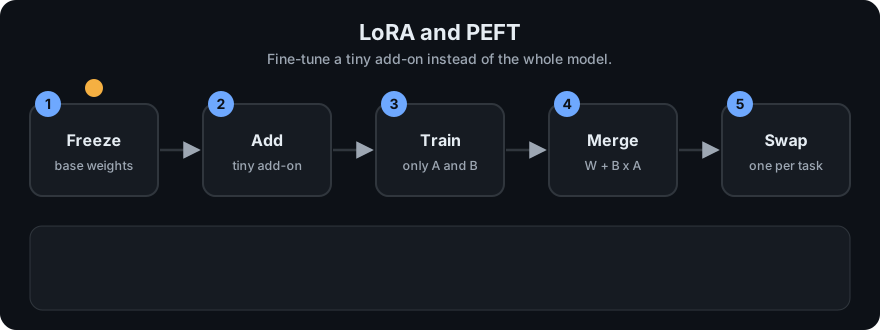
It plays on a loop. Read the caption in the box, one step at a time. Want to go at your own pace? Step through it with Previous and Next.
How it works
- Why full fine-tuning is expensive. For each trained parameter you keep the weight (2 bytes in 16-bit), its gradient (2 bytes), and the optimizer state. The common Adam optimizer keeps two extra 32-bit numbers (8 bytes). That is about 12 bytes per parameter, so a 7B model needs roughly 84 GB before counting activations. Many setups use even more.
- Freeze the weight matrix W (size d × d). It never changes.
- Learn a low-rank update. Make two small matrices: B (d × r) and A (r × d), where the rank r is small, like 8. Their product B·A is d × d, but it can only carry r "directions" of change.
- Add it with a scale: W' = W + (alpha / r) × B·A. The number alpha sets how strongly the update counts. B starts at zero, so at the start the model is exactly the original.
- Count the parameters. One d × d matrix has d² parameters. The adapter has d×r + r×d = 2×d×r. For d = 4096 and r = 8, that is 16,777,216 versus 65,536. That is 256 times fewer, or 0.39%.
- Choose target modules. You pick which matrices get an adapter. Common picks are the attention query and value projections. Adding more modules, or raising r, gives more capacity and more memory use.
- Merge or keep separate. After training you can fold B·A into W, so inference costs exactly the same as the base model. Or you keep the adapter as a small file and load it on demand.
flowchart LR
    X[Input x] --> W[Frozen W]
    X --> A[A: r x d, trained]
    A --> B[B: d x r, trained]
    B --> S[Scale alpha / r]
    W --> P((Add))
    S --> P
    P --> Y[Output]
QLoRA is LoRA on a base model that is stored in 4-bit (see Quantization). The frozen weights are small, and only the adapter is trained in higher precision. This lets a large model be fine-tuned on a single GPU. Read the QLoRA paper for details.
Swapping adapters. One base model plus many small adapters can serve many tasks or customers. You load the right adapter for each request. Each file is megabytes, not gigabytes.
What LoRA cannot fix. It does not add reliable new facts (use RAG). It does not give the model skills it is far from having. Bad data still gives a bad adapter. A low rank can also underfit a hard task, and a high learning rate can make the model forget other abilities. Always test against the base model.
Worked example
Use a tiny 4×4 matrix W with rank r = 1:
- A is 1×4 and B is 4×1, so they hold 4 + 4 = 8 numbers. W holds 16.
- B·A is a full 4×4 grid, built from only those 8 numbers.
- B starts at zero, so W' = W at the start and the model is unchanged.
- Training moves A and B only. W' = W + (alpha / r) × B·A then changes the output, while W itself never changes.
Code example
The demo uses plain Python lists, so every number is hand-checkable. Run it: python 03-llm-concepts/code/llm_lora_math.py
from llm_lora_math import merge, adapter_forward, matvec

W = [[1, 0, 0, 0], [0, 1, 0, 0], [0, 0, 1, 0], [0, 0, 0, 1]]   # frozen base
B = [[1, 0], [0, 1], [1, 1], [0, 2]]                            # 4 x 2
A = [[1, 0, 2, 0], [0, 1, 0, 1]]                                # 2 x 4
x = [1, 2, 3, 4]
print(matvec(merge(W, B, A, alpha=4, r=2), x))      # -> [15.0, 14.0, 29.0, 28.0]
print(adapter_forward(W, B, A, alpha=4, r=2, x=x))  # -> [15.0, 14.0, 29.0, 28.0]
The real output of the full demo is:
one 4096x4096 matrix: full 16,777,216 params | LoRA r=8 65,536 params | 0.3906% of full
32 layers x 2 matrices x 65,536 = 4,194,304 trainable params
7B full fine-tune ~ 84 GB | 7B LoRA ~ 14.04 GB (before activations)

Tiny 4x4 example, r=2, alpha=4 (scale alpha/r = 2):
B @ A      = [[1, 0, 2, 0], [0, 1, 0, 1], [1, 1, 2, 1], [0, 2, 0, 2]]
W' rows    =
   [3.0, 0.0, 4.0, 0.0]
   [0.0, 3.0, 0.0, 2.0]
   [2.0, 2.0, 5.0, 2.0]
   [0.0, 4.0, 0.0, 5.0]

W' @ x          = [15.0, 14.0, 29.0, 28.0]
adapter forward = [15.0, 14.0, 29.0, 28.0]

Rank check (r=1): B is a column, A is a row
   [3.0, 0.0, 1.0, 2.0]
   [6.0, 0.0, 2.0, 4.0]
   [-3.0, 0.0, -1.0, -2.0]
   [0.0, 0.0, 0.0, 0.0]
all rows proportional (rank <= 1): True
identity matrix rows proportional: False
Three things to notice. First, the 7B memory numbers are a rule of thumb: 12 bytes per parameter for full training, versus 2 bytes for the frozen weights plus 10 bytes for only the 4,194,304 trainable ones. The adapter case is dominated by the frozen 16-bit weights (14 GB), which is why QLoRA shrinks them to 4-bit. Second, the merged weight and the separate adapter give the same output, so merging loses nothing. Third, a rank-1 update has rows that are all multiples of one row, which shows the update can only carry r directions.
The tests in test_llm_lora_math.py check the hand-worked matrices, the parameter counts, merge versus separate output, and that a zero B leaves the model unchanged.
In real projects use the Hugging Face PEFT library. Its API changes, so check the current PEFT docs and repo rather than copying old snippets. For the 4-bit base in QLoRA, see bitsandbytes. The original method is in the LoRA paper.
When to use it / when not to
| Situation | Use LoRA? |
|---|---|
| Full fine-tuning does not fit in your GPU memory | Yes. LoRA, or QLoRA if still too big |
| One base model, many tasks or customers | Yes. Keep one small adapter per task |
| You need a style, format or narrow skill | Yes, after prompting has failed |
| The model needs new, changing facts | No. Use RAG |
| The task is far from anything the base model can do | Maybe not. Low rank may underfit, so try a higher r or a different base |
| A hosted provider offers fine-tuning and you do not need to own the weights | Probably use the provider's service |
Common mistakes
- Thinking LoRA needs no memory for the base. The frozen weights still sit in memory (that is what QLoRA shrinks).
- Setting rank very high "to be safe". Capacity and memory grow with r, and so can overfitting.
- Changing alpha and r separately without noticing that the effective scale is alpha / r.
- Merging an adapter into a quantized base without checking the result.
- Comparing only against the training set. Test on held-out examples and against the base model.
- Using an adapter with a different base model version than the one it was trained on.
Recap
If you remember only three things:
- LoRA freezes the weights and trains two small matrices whose product is added to W.
- For d = 4096 and r = 8 that is 65,536 trained numbers instead of 16,777,216 (0.39%).
- QLoRA adds a 4-bit base model for more savings. LoRA still does not add reliable facts.
Interview questions
<details> <summary><b>1. Why does LoRA use far fewer trainable parameters than full fine-tuning?</b></summary>
Instead of updating a d × d matrix (d² parameters), it learns B (d × r) and A (r × d), which is 2×d×r parameters. For d = 4096 and r = 8 that is 65,536 instead of 16,777,216. Gradients and optimizer state are also only kept for those few parameters. </details>
<details> <summary><b>2. What are rank r and alpha, and how do they interact?</b></summary>
The rank r is the inner size of the update, so it limits how many independent directions the change can have, and sets the adapter size. Alpha is a scaling number: the update is multiplied by alpha / r. Raising r adds capacity, and alpha / r controls how loud the update is relative to the frozen weight. </details>
<details> <summary><b>3. How is QLoRA different from LoRA, and what can neither one do?</b></summary>
QLoRA keeps the frozen base in 4-bit, so far less memory is needed, and trains a normal LoRA adapter on top. Neither one is a reliable way to add new facts, to give citations, or to rescue a bad dataset. Use RAG for facts and clean data for quality. </details>
Go deeper
- LoRA paper: https://arxiv.org/abs/2106.09685
- QLoRA paper: https://arxiv.org/abs/2305.14314
- Hugging Face PEFT docs: https://huggingface.co/docs/peft/index
- PEFT repo: https://github.com/huggingface/peft
- bitsandbytes: https://github.com/TimDettmers/bitsandbytes
Prev: Quantization · Next: Inference Serving and Batching · Back to phase: Phase 3