Beam Search
In short: Beam search keeps the few best partial sentences at each step instead of only the single best token, so it can find a more likely full sentence than greedy decoding.
On this page
Level: Intermediate · Reading time: 8 min · Phase: 3 · LLM Concepts
Before you start: Temperature and Top-p (they cover probabilities and sampling, the alternative to beam search).
Words to know:
- Greedy decoding: always taking the single most likely next token.
- Beam: one partial sentence the search is still extending, with its score.
- Beam width: how many beams are kept at each step.
- Log-probability: the logarithm of a probability. Adding log-probabilities equals multiplying probabilities.
- Length penalty: an adjustment so that short sentences are not unfairly favoured.
Explain it like I'm new
Imagine planning a road trip by always taking the road that looks fastest at each junction. That's greedy. Sometimes the fastest-looking first road leads to a traffic jam later. A smarter planner keeps the 3 best routes so far at every junction, extends each one, and again keeps the best 3. That is beam search, and 3 is the beam width.
For language models, a "route" is a sequence of tokens and its "score" is how probable the whole sequence is. Because multiplying many small probabilities gives tiny numbers, we add log-probabilities instead (log turns multiplication into addition).
Beam search is deterministic: same input, same output. It is popular for tasks with one "right" answer, such as translation and speech recognition, and less common for chat.
Watch it
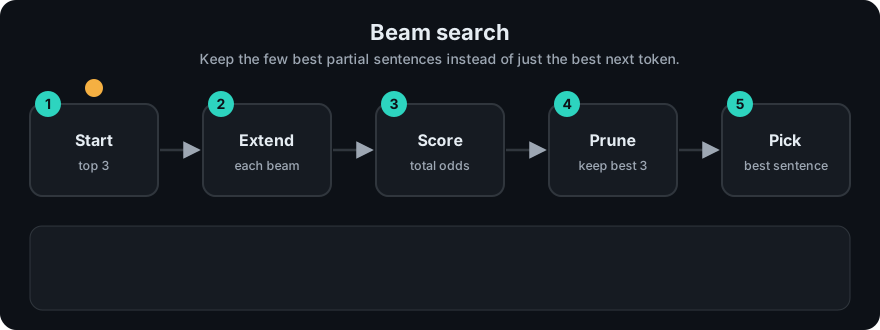
It plays on a loop. Read the caption in the box, one step at a time. Want to go at your own pace? Step through it with Previous and Next.
How it works
- Start with one beam: the empty sequence, score 0.
- For every beam, list every possible next token and its new score:
score + log P(token | sequence). - Collect all candidates and keep the top
B(the beam width). - Move any candidate ending in an end token to a "finished" list.
- Repeat until no beams are left or a length limit is hit.
- Return the best finished sequence (often with a length penalty so short sentences aren't unfairly favoured).
Worked example with the toy table in llm_decoding.py:
<start> -> the 0.5 | a 0.4 | my 0.1
the -> cat 0.4 | dog 0.35 | big 0.25        a -> dog 0.9 | cat 0.1
cat -> sat 0.6 | ran 0.3 | <end> 0.1        dog -> ran 0.5 | sat 0.4 | <end> 0.1
Greedy: the (0.5) → cat (0.4) → sat (0.6) → <end>. Probability 0.5 × 0.4 × 0.6 = 0.12.
Beam, width 2:
step 1: keep  the (0.50), a (0.40)
step 2: candidates  the cat 0.20, the dog 0.175, the big 0.125, a dog 0.36, a cat 0.04
        keep  a dog (0.36), the cat (0.20)
step 3: candidates  a dog ran 0.18, a dog sat 0.144, the cat sat 0.12, ...
        keep  a dog ran (0.18), a dog sat (0.144)
result: "a dog ran"  probability 0.4 × 0.9 × 0.5 = 0.18  > greedy's 0.12
Greedy lost because "a" looked worse than "the" at step 1, but led to a much better continuation.
Worked example (why logs help)
Using the same table, score the two full sentences with logs (natural log, rounded):
- Greedy
the cat sat: log 0.5 = -0.69, log 0.4 = -0.92, log 0.6 = -0.51. Add them: -2.12. - Beam
a dog ran: log 0.4 = -0.92, log 0.9 = -0.11, log 0.5 = -0.69. Add them: -1.72. - -1.72 is higher (closer to 0) than -2.12, so
a dog ranwins. That matches the probabilities: 0.18 beats 0.12. - The code prints exactly this: beam
a dog ran <end>against greedythe cat sat <end>.
flowchart LR
    S((start)) --> T[the 0.50]
    S --> A[a 0.40]
    A --> AD[a dog 0.36]
    T --> TC[the cat 0.20]
    AD --> ADR[a dog ran 0.18]
    TC --> TCS[the cat sat 0.12]
Code example
From llm_decoding.py:
import math
from llm_decoding import next_probs, END, greedy, sequence_logprob

def beam_search(beam_width=2, start="<start>", max_len=10):
    beams, finished = [([start], 0.0)], []
    for _ in range(max_len):
        candidates = []
        for seq, lp in beams:
            for tok, pr in next_probs(seq[-1]).items():
                cand = (seq + [tok], lp + math.log(pr))
                (finished if tok == END else candidates).append(cand)
        if not candidates:
            break
        beams = sorted(candidates, key=lambda c: c[1], reverse=True)[:beam_width]
    finished.extend(beams)
    best = max(finished, key=lambda c: c[1])
    return best[0][1:], best[1]

seq, lp = beam_search(2)
print(seq, round(math.exp(lp), 3))                         # ['a', 'dog', 'ran', '<end>'] 0.18
print(greedy(), round(math.exp(sequence_logprob(greedy())), 3))  # ['the', 'cat', 'sat', '<end>'] 0.12
In real projects (Hugging Face Transformers):
out = model.generate(**inputs, num_beams=4, do_sample=False, max_new_tokens=50, early_stopping=True)When to use it / when not to
- Use for tasks with a narrow correct output: translation, speech-to-text, short structured outputs.
- Avoid for open-ended chat or creative text. It tends to be repetitive and generic; top-p sampling usually reads better.
- Cost grows with beam width:
Bbeams means aboutBtimes the compute per step.
| Strategy | Deterministic | Variety | Typical use |
|---|---|---|---|
| Greedy | yes | none | quick, exact tasks |
| Beam search | yes | low | translation, ASR |
| Top-k / top-p sampling | no | tunable | chat, creative writing |
Common mistakes
- Multiplying raw probabilities and hitting floating-point underflow. Use log-probabilities.
- No length normalization, so the search prefers very short outputs.
- Very large beam widths. They can make output worse (more generic), not better.
- Expecting beam search to fix factual errors. It finds likely text, not true text.
Recap
If you remember only three things:
- Beam search keeps the best B partial sentences at each step, so it can recover from a first choice that looked worse.
- It adds log-probabilities to score whole sentences, and it is deterministic: same input, same output.
- It suits translation and speech recognition, but is too bland and repetitive for open-ended chat.
Interview questions
1. How is beam search different from greedy decoding? <details><summary>Answer</summary> Greedy keeps one sequence and picks the top token each step. Beam search keeps the B best partial sequences by total log-probability, which lets it recover from a choice that looked worse early but leads to a more probable whole sequence. </details>
2. Why use log-probabilities? <details><summary>Answer</summary> Products of many probabilities underflow to zero. Logs turn products into sums, which are numerically stable, and ranking is unchanged because log is increasing. </details>
3. Why is beam search rarely used for chatbots? <details><summary>Answer</summary> High-likelihood text tends to be bland and repetitive. Sampling methods such as top-p give more natural, varied responses. Beam search also costs more compute per token. </details>
Go deeper
- Sequence to Sequence Learning with Neural Networks (Sutskever et al., 2014)
- The Curious Case of Neural Text Degeneration (Holtzman et al., 2019)
Prev: Top-p · Next: Hallucination · Back to phase: Phase 3